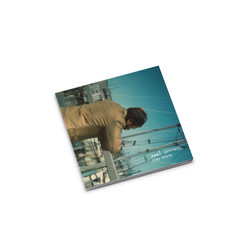
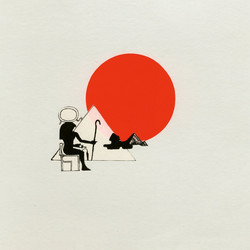
** 2026 Repress ** The Will Come Is Now is the long‑deferred moment when Ronnie Boykins stops being a rumour in the liner notes and becomes a world‑builder in his own right. Known first and foremost as the foundation of Sun Ra’s Arkestra through some of its most explosive years, Boykins had been earmarked for a leader date as early as 1964. A decade later, in February 1974, he finally walked into the studio to make good on that invitation, bringing with him not just a bass, but a book of music that makes it clear how much of his time with Sun Ra was spent studying structure, not just holding down the low end.
The album’s septet line‑up is key. Rather than choosing a stripped‑down trio or quartet, Boykins surrounds himself with a small orchestra, capable of the same kind of colour shifts and massed voicings he would have known from the Arkestra, but on a more intimate scale. His six originals roam across a surprising range: tunes that nod to marching‑band swagger and Ellingtonian swing; others that lean into modal vamp and open‑form exploration; passages where written horn lines suddenly open up into ragged, exuberant collective improvisation. You can hear Sun Ra’s ghost at the edges – in the way harmonies tilt toward the astral, in pockets of free rhythm – but the centre of gravity is different. Boykins’s sensibility is earthier, more anchored in pulse and song form, less interested in theatre than in the internal life of the ensemble.
As a bassist, he uses the opportunity to show facets that were often submerged in larger bands. The “all‑natural” bass sound is striking: no fuzz, no studio sweetening, just wood, string and the air of the room, captured at a time when many recordings had moved toward more processed low‑end. His pizzicato playing is propulsive but melodic, lines that walk, dance and comment rather than simply marking time. It’s his arco work, though, that really startles – big, singing tones that can function as an extra horn, keening above the group, or as a grainy drone underpinning the rest of the arrangement. You get a sense of someone who has thought long and hard about how the bass can step forward without breaking the ensemble’s balance.
The writing mirrors that duality of anchor and flight. Boykins arranges so that the bass is always central, but rarely dominant: themes are passed around the band, inner voices are given their own trajectories, rhythmic figures interlock rather than simply sit on top of one another. The “variety of moods and textures” isn’t just programming; it’s encoded in the way he deploys his forces. One piece might open with a knot of horns over loose drums, then snap into a unison riff that suddenly makes sense of the apparent chaos. Another might build from a simple ostinato into a dense swarm of counter‑lines, only to dissolve into near‑silence with just bass and one horn left standing.
What keeps The Will Come Is Now from feeling like a spin‑off is precisely that tension between familiarity and self‑definition. Listeners who know Boykins only as the gravitational centre of Sun Ra’s music will recognise certain gestures – intervallic leaps in the lines, a fondness for minor‑key modes that seem to open onto other planets – but they’ll also hear a quieter, sturdier voice asserting itself. This is music less concerned with spectacle and more with the long, slow burn of a group that knows how to listen and respond. As a first and only statement under his own name, it lands somewhere between manifesto and coded diary: a record that says, in its title and its sound alike, that the time for the sideman to speak had finally arrived.