We use cookies on our website to provide you with the best experience. Most of these are essential and already present.
We do require your explicit consent to save your cart and browsing history between visits. Read about cookies we use here.
Your cart and preferences will not be saved if you leave the site.
play

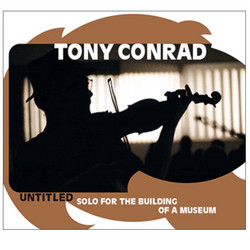
Tony Conrad

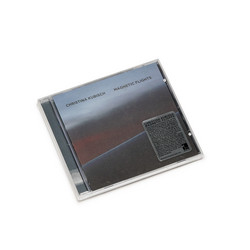
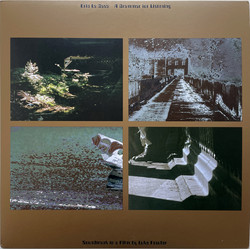
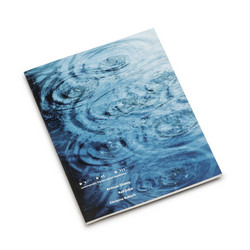
Untitled - Solo for the Building of a Museum (CD)

Label: Sub Rosa

Format: CD

Genre: Experimental

Preorder: Releases September 30th, 2026

€12.20
VAT exempt
+
-
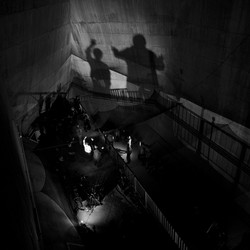
On Untitled (Solo for the Building of a Museum), Tony Conrad stages an unseen encounter between amplified violin and his self-built Long String Instrument. Recorded in 2002 behind a concealing sheet, the performance turns drone, friction and physical resonance into an act of radical listening - music whose hidden actions remain inseparable from its vast, exposed sound.

Untitled (Solo for the Building of a Museum) captures Tony Conrad in 2002, working with the two instruments most central to his practice at the time: amplified violin and his self-built Long String Instrument. Performed behind a large sheet, with the nature of the action deliberately withheld from the audience, the piece transforms concealment into an essential compositional force. Listeners are not given a visual explanation, a set of gestures to follow, or the reassurance of knowing where one sound begins and another ends. Instead, they are asked to confront the sound directly - its pressure, vibration, duration and physical effect on the room.

Conrad’s Long String Instrument was not a conventional instrument in any familiar sense. Built from long, tensioned strings and amplified into monumental presence, it functioned as a kind of extended monochord, capable of producing dense, low-frequency drones, abrasive glissandi and beating harmonic fields. Conrad described related versions of the instrument as a long string drone, an abbreviation that mischievously echoed LSD, and the name suits the experience: sustained sound becomes spatial, visual and bodily, altering the listener’s sense of scale. The instrument does not simply provide a bass foundation. It creates an environment in which every other sound has to exist.

Against this long-string mass, Conrad’s amplified violin becomes both counterpart and disturbance. His bowing practice is famously patient and exacting, built around sustained tones, just intonation, minute shifts of pitch and the emotional heat produced when closely aligned frequencies begin to beat against one another. The violin does not supply melody in the ordinary sense; it stretches sound until pitch reveals its inner turbulence. Over time, the ear begins to hear more than the apparent material: phantom rhythms emerge from interference patterns, overtones expand into their own shimmering voices, and a single sustained note acquires the density of a whole ensemble.

The decision to perform behind a sheet intensifies this experience. With the visual event obscured, the audience cannot use spectacle to orient itself. The room becomes a kind of museum under construction, a site where objects, bodies, resonance and hidden labor are reorganized through sound. What happened behind the fabric was never disclosed, and that refusal matters. Conrad was never interested in offering music as transparent virtuosity; his work repeatedly asks what occurs when performance is treated as a material process rather than a display of mastery. Here, the hidden action makes the audible event more immediate, not less. Every scrape, surge and sustained vibration seems charged by the awareness that its source remains just beyond reach.

The recording belongs to the wider continuum of Conrad’s radical minimalism, a practice that extended across experimental music, film, video art, sculpture, teaching and instrument building. For more than five decades, he pursued an expanded understanding of duration, amplification and precise tuning. Works such as Ten Years Alive on the Infinite Plain established his ability to turn amplified strings and low-frequency drone into immersive, nearly architectural environments; Untitled (Solo for the Building of a Museum) strips that impulse to a more solitary and secretive form. There is no need for narrative development or ornamental variation. The drama lies in sound’s gradual occupation of space.

This is music that does not request passive appreciation. It asks the listener to remain with the material long enough for it to alter perception. The long string’s low end can feel less heard than physically encountered; the violin’s high, sustained frequencies create an unstable, luminous ceiling above it. Between them, Conrad makes a field of tension in which time slows down, the boundaries of the instruments blur and the building around the performance seems to become part of the score.

Details
Cat. number: SR602
Year: 2026