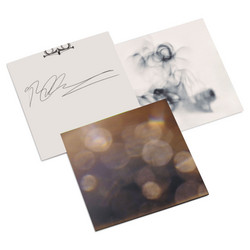
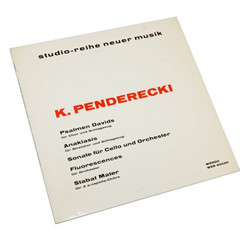
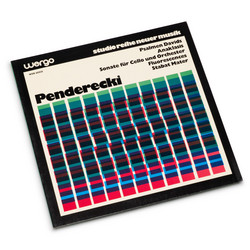
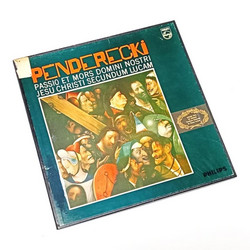
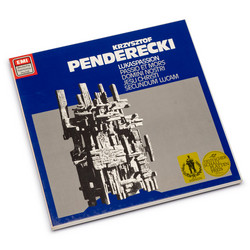
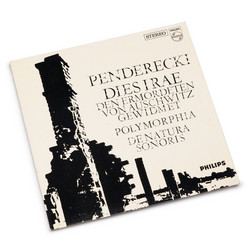
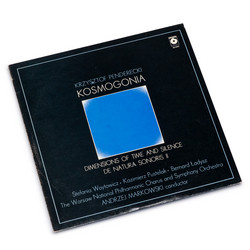
condition (records/cover): NM / EX Gatefold sleeve.
Two parts, composed in 1970 and 1971, for five vocal soloists, two mixed choirs, and symphony orchestra. Together they form a diptych - or, with the St. Luke Passion, a triptych - that stands as Krzysztof Penderecki's most sustained engagement with the sacred, and specifically with the Eastern Orthodox liturgical tradition rather than the Latin Catholic one in which he was raised.
The decision was deliberate. After the St. Luke Passion and Dies Irae, Penderecki was drawn to the emotional intensity and archaic authority of Byzantine and Slavic Orthodox music - to the drone-based chant of the Octoechos, to the antiphonal structures of the Matins service, to the Old Church Slavonic texts that carry a different weight from their Latin equivalents. Part I, The Entombment of Christ, is built on the liturgy of Holy Saturday: lamentation over the dead Christ, the harrowing of Hades, the sepulchral depth of the basses that open the work. Part II, The Resurrection of Christ, turns to Easter Matins - fanfares, jubilant polyphony, the cry "Christ is Risen" - the same sonic materials now transfigured. Penderecki's description of the work as "a combination of pure, a cappella vocal writing and orchestral effects very much connected with electronic music" gives only a partial sense of what it achieves.
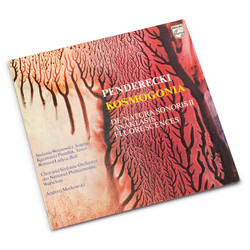
Parts of Utrenja appear in Stanley Kubrick's The Shining (1980), where their liturgical gravity was deployed for atmospheric effect. They sound different in their proper context. Both parts conducted by Andrzej Markowski, the conductor who premiered them, with the Warsaw National Philharmonic Orchestra and Chorus. Original Muza 2LP pressing.