Krzysztof Penderecki
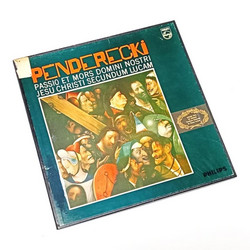
Lukaspassion (2LP box)
condition (records/box): NM / EX + Insert included.
The most important single work in Krzysztof Penderecki's career, and one of the defining documents of European music in the second half of the twentieth century. Composed between 1963 and 1966, commissioned by the Westdeutscher Rundfunk to mark the seven-hundredth anniversary of Münster Cathedral, the St. Luke Passion premiered there on 30 March 1966 - a date that landed within the millennial celebrations of Polish Christianity. Penderecki later said that this was not accidental: he had chosen the subject deliberately, for the anniversary. The premiere, and the ten Polish performances that followed within six months - one at Wawel Castle in Kraków attended by an audience of fifteen thousand - functioned as acts of collective religious defiance in a state that had decreed the celebrations secular.
The work is set for three soloists (soprano, baritone, bass), a speaking Evangelist, three four-part choruses plus a fourth chorus of sopranos and altos, and large orchestra. The text is Latin, drawn primarily from Luke but supplemented with passages from John, the Psalms, and the Roman liturgy. Structurally, it takes the Bach Passions as its model while refusing their tonal language: the music is almost wholly atonal, tone clusters and glissandi forming the dense harmonic environment through which the vocal lines move. Two moments of tonal resolution punctuate the darkness - a D major triad at the close of the Stabat Mater section, and the final E major chord that ends the work, arriving with the effect of a light switched on in a dark room. Penderecki himself described the Passion's almost total atonality as the only truthful language after Auschwitz. But what the work achieves is not abstraction - it is, among the most technically radical large-scale sacred works of the twentieth century, one of the most viscerally direct.
Original Muza 2LP pressing, with the score recorded by Polskie Nagrania. The canonical document of a canonical work.