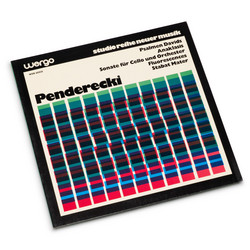
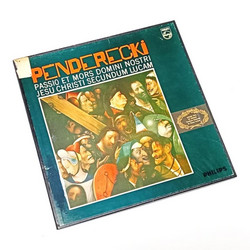
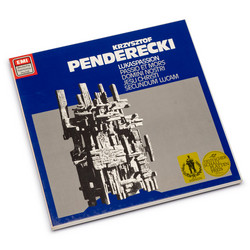
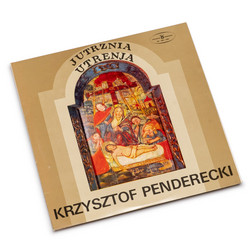
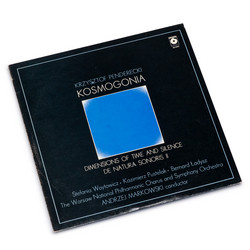
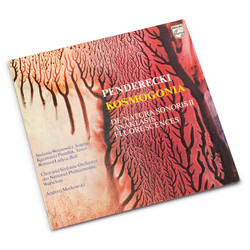
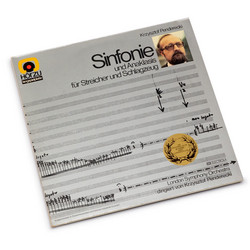
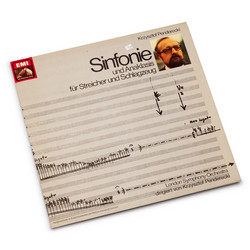
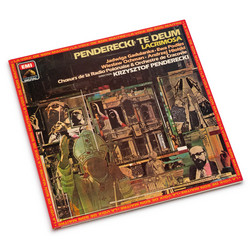
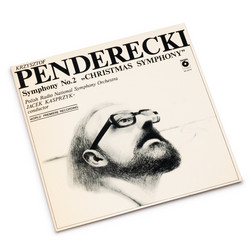
Krzysztof Penderecki
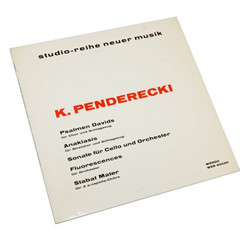
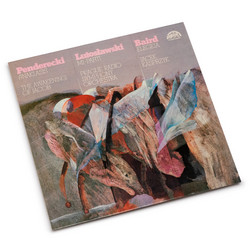
Dies Irae (Auschwitz Oratorium) / Polymorphia / De Natura Sonoris (LP)
condition (record/cover): NM / NM - Insert included.
Three works, two of them already canonical by the time the LP appeared in 1967, and one composed in nine weeks in direct response to a commission from the city of Kraków for the twentieth anniversary of the liberation of Auschwitz.
Polymorphia (1961), for 48 string instruments, was one of the works that established Krzysztof Penderecki at the center of the European avant-garde in the early 1960s. It deploys the string orchestra not as a collection of individual voices but as a single large resonating body, moving through tone clusters, glissandi, and textures of extraordinary density toward a final chord of pure C major that arrives, in context, less as resolution than as shock. De Natura Sonoris (1966) extends this thinking to the full orchestra, the title's reference to Lucretius announcing an inquiry into the nature of sound itself rather than a musical argument.
Dies Irae (1967), for soloists, chorus, and orchestra, is the work that takes this language directly into historical reckoning. Its three movements - Lamentatio, Apocalypsis, Apotheosis - set texts drawn from the Bible, Aeschylus, Aragon, Broniewski, and Różewicz, the Latin and Polish voices layered against each other across a sonic landscape built from the same extended techniques as the earlier orchestral works, but now freighted with specific memorial weight. The premiere took place on April 16, 1967 at the Auschwitz monument. Penderecki himself described what happened after Fluorescences as the closing of one door; Dies Irae shows what lay behind the next one.
Soprano Stefania Woytowicz, tenor Wiesław Ochman, bass Bernard Ładysz; Chorus and Orchestra of the Kraków Philharmonia under Henryk Czyż. Original Philips pressing with gatefold sleeve and 7-page booklet with librettos in Polish, English, and German.