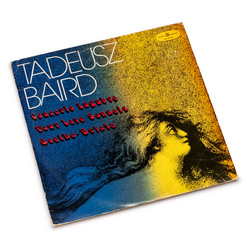
condition (record/cover): NM / VG+ (1" sticker removal damage on back) Gatefold sleeve.
The Polish Requiem was not composed as a unified work. It accumulated over four years, movement by movement, each section attached to a specific event or person in the contemporary history of Poland under communist rule. Krzysztof Penderecki began in 1980 with the Lacrimosa, commissioned by Solidarity and dedicated to Lech Wałęsa for the unveiling of a monument at the Gdańsk Shipyard to those killed in the 1970 anti-government riots. The Agnus Dei followed in 1981, written in memory of Cardinal Stefan Wyszyński, the spiritual leader of the Polish nation who had been imprisoned for three years. The Recordare came in 1982, for the beatification of Maximilian Kolbe, the Franciscan priest murdered at Auschwitz who had volunteered to die in place of a condemned stranger. The Dies Irae commemorated the Warsaw Uprising; the Libera me, Domine the victims of Katyń.
Penderecki later insisted he did not write political music: "Political music is immediately obsolete. My Threnody to the Victims of Hiroshima remains important because it is abstract music. The Requiem is dedicated to certain people and events, but the music has a broader significance." The distinction is real. What the dedication structure created was not a political document but something more durable - a work whose individual movements carry the weight of specific grief while the overall arc follows the liturgical form of the requiem mass toward something that could be called, without sentimentality, hope. The text is the Latin of the traditional requiem, augmented by the Polish Święty Boże - a prayer sung in Poland in moments of national danger.
First performed in Stuttgart on 28 September 1984, under Mstislav Rostropovich. This original Muza 2LP pressing documents the work as it stood before the later additions of the Sanctus and Ciaccona, and represents the form in which the work first reached its audience during the final years of martial law.