Krzysztof Penderecki
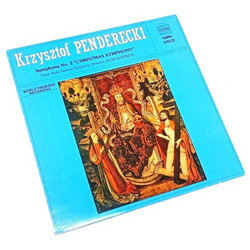
Symphony No. 2 Christmas Symphony (LP)
condition (records/cover): NM / EX
The Second Symphony arrived at a moment when Krzysztof Penderecki's stylistic turn had already been clear for several years and the controversy was already loud. After the First Symphony (1973) had begun to move away from tone clusters and graphic notation, and after the Violin Concerto (1977) and several subsequent works had confirmed the direction, the Second Symphony - composed in the winter of 1979-80 - gave critics something genuinely difficult to process. It was not an abandonment of contemporary technique but a reorganization of priorities, the language of late Romanticism absorbed rather than quoted, modified sonata form in one movement, Bruckner and Sibelius somewhere in the bloodstream.
The "Christmas Symphony" nickname came from a specific compositional event: Penderecki had been struggling to complete the work when, at Christmas 1979, the opening phrase of "Silent Night" appeared in the material and unlocked the rest. It occurs three times in the score, briefly, "almost as if in passing, like music from a distant memory or a recollection from childhood," as one commentator put it. In Poland, where the work was heard against the backdrop of Solidarity's rise and the recent election of the first Polish pope, it was received as something close to national music - the subjectively romantic tone carrying a specific historical weight in that moment. The premiere, conducted by Zubin Mehta with the New York Philharmonic on 1 May 1980, generated the predictable critical controversy in the West. Polish audiences heard it differently. Original Muza pressing.