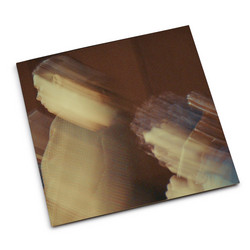
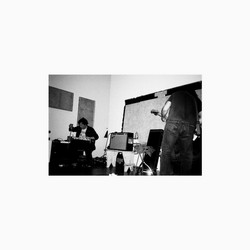
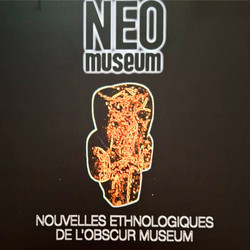
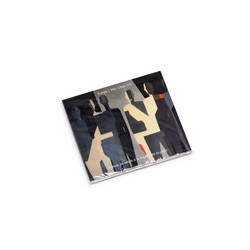
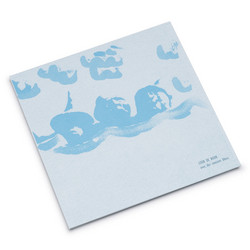
Nouvelles Ethnologiques de l’Obscur Museum preserves the sole full-length statement by NEO Museum, one of the most distinctive groups to emerge from the extraordinary new-music climate of Vandœuvre-lès-Nancy in the mid-1980s. Formed in 1984 by saxophonist Alain Casari, guitarist Antoine Gindt and drummer Daniel Koskowitz, the group grew from the fertile aftermath of Hellebore but took its own, more concentrated route. Where Hellebore had opened a porous borderland between prog, experimental rock and contemporary composition, NEO Museum intensified the encounter: a compact trio designed to make freer forms, sharper structures and harder-edged collective sound.
The record, originally released in 1986 on Ayaa as Volume 1. Nouvelles Ethnologiques de l’Obscur Museum, was recorded during February, November and December 1985, then mixed in January 1986 at the studio of the Centre Culturel André Malraux in Vandœuvre-lès-Nancy. It remains the fullest document of a repertoire developed on stages in France and abroad, and of a group for whom composition and improvisation were not opposing practices but mutually activating forces. The opening sequence of Une Sidérurgie pieces makes the point immediately: industrial in title and tensile in feel, these works construct their force from nervous saxophone lines, jagged guitar forms, angled rhythmic breaks and a refusal to settle into genre comfort.
Casari’s alto saxophone is central to the album’s exploratory drive. Trained in Metz and deeply affected by twentieth-century figures including Karlheinz Stockhausen, Luciano Berio, La Monte Young, Giacinto Scelsi and Mauricio Kagel, he brought a compositional ear for timbre, sustained sound and structural tension into the rougher, more physical context of a rock-adjacent ensemble. His practice was never limited to music alone: encounters with Hellebore in 1981 opened a path across sound, architecture and visual art, a crossing he would later formalize through work in architecture and urban planning. On this album, the saxophone can behave like an instrument of melodic attack, granular noise or spatial architecture, rising above the group one moment and disappearing into its dense mechanics the next.
Gindt answers with guitar, bass and occasional piano, bringing a restless sense of form that later made him a significant figure in French contemporary music and in the development of Musique Action. His playing refuses guitar-rock cliché. Phrases arrive like broken beams of light: clipped, abrasive, harmonically unsettled, sometimes carrying a trace of blues or rock, more often derailing it. Koskowitz provides the crucial third side of the triangle, a drummer equally at home in contemporary music, free improvisation, noise rock and electronic experimentation. His percussion is hard and economical, less a timekeeping device than an active compositional partner, capable of locking the trio into sudden force or breaking its momentum open from within.
The trio is joined on selected pieces by an expanded cast of fellow travelers: Pascal Sieger on sopranino saxophone, Raoul Binot on tenor saxophone, Jacques Veillé on trombone and Jérôme Bourdellon on bass clarinet and bass flute. Their appearances widen the record’s palette without diluting its essential focus. In Premier Élément, brass and reeds expand the group’s language into a more volatile ensemble statement; Éléments de Paraphrase continues the process of interruption and reassembly; and the extended Rahcuoba Pro Afghan closes the original program with a nine-minute plunge into dense, multi-directional sound. The music can recall the radical rock of the Rock in Opposition tradition, but its strongest identity lies in its own finely balanced violence and restraint.
In 1986, pianist Jean-Michel Albertucci joined NEO Museum for a live score to G. W. Pabst’s restored silent film Lulu, performed in Vandœuvre-lès-Nancy, Bruges, Nancy, Zagreb, Belgrade and Montpellier, among other cities. The project illustrates the group’s broader ambition: music as a site of cinematic, architectural and theatrical encounter. By the time NEO Museum dissolved in 1988, each member had already established a practice reaching well beyond the band. Casari continued to bridge architecture, improvisation and electronic music; Gindt became a leading interpreter and organizer in contemporary music; Koskowitz developed work for dance, theatre and multimedia before joining Art Zoyd, with whom he remained from 2004 to 2020.
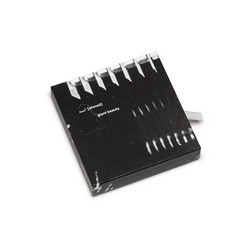
This reissue offers a renewed opportunity to hear NEO Museum not as a lost footnote but as a vital chapter in French experimental music. The CD edition adds rare and previously unreleased recordings, extending the picture of a short-lived but highly productive group. Nouvelles Ethnologiques de l’Obscur Museum still sounds bracing because it treats risk as an everyday condition: every player listens, interrupts, proposes and rebuilds. What remains is music with edges - fierce, intricate and insistently alive.