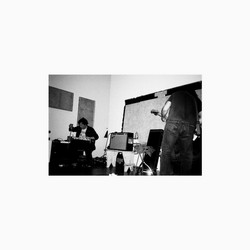
A Cold Night in Rome documents a legendary 2007 concert by Gregorio Bardini, staged in the Italian capital under the auspices of the English label Cold Spring. The event gathered a line-up that included Rose Rovine e Amanti, Forthcoming Fire, Von Thronstahl, Si Vis Pacem Parabellum and Bardini himself - a meeting point for artists working at the outer edges of industrial, neofolk, experimental noise and ritual music. But Bardini’s set belongs to no single scene. It carries the energy of industrial confrontation while opening onto something older, more porous and more difficult to name: a music of breath, memory, folk resonance and sonic fracture.
An Italian flutist, composer and musicologist, Bardini has crossed some of the most vital currents of the Italian industrial movement since the 1980s. His work with Tomografia Assiale Computerizzata (T.A.C.), Kino Glaz, Thelema and Razza Ventura established a personal language in which electronics, acoustic instruments, voice, folk traditions and contemporary composition can occupy the same unstable terrain. His deep interest in ethnic and folk music - especially Armenian traditional music - and in contemporary classical practice gives his sound an unusual identity. Ancient resonance and avant-garde disturbance are not opposite poles here; they are materials that speak through one another.
The opening track, Sernesi, named in dedication to a painter and patriot of the Italian Risorgimento, establishes this tension immediately. Abrasive noise textures press against the listener before the piece opens into an exchange between flute and electronics. Bardini’s flute does not arrive as a soothing corrective to the noise. It moves through the interference as another form of intensity: breath becomes a physical force, the instrument’s woody, human grain set against harsher electrical surfaces. The piece frames one of the album’s persistent questions - how can historical memory be sounded without being turned into monument?
The title work is the release’s core and tour de force. Across more than thirty minutes, A Cold Night in Rome builds a dense, emotionally charged sequence from voices, noise inserts, bagpipes and Bardini’s flute. It opens with the metallic, disembodied voice of Ezra Pound, a loaded presence whose words arrive less as literary quotation than as damaged sonic material. From there, the performance moves through a changing field of drones, ruptures and fevered instrumental exchange. Damiano Mercuri and Pamela Gargiuto of Rose Rovine e Amanti contribute distorted guitar and violin, expanding the music into a raw collective body. Their parts scrape, swell and cut through the texture, sometimes reinforcing its industrial severity, sometimes exposing a more elegiac and almost folk-inflected core.
The shorter pieces continue to shift the record’s perspective. Leale Martelli brings breath-driven vocal fragments forward against unsettling interference, making language feel unstable, half-heard and caught in the machinery around it. Macchiaioli takes another route, combining strings, sliding electronics and ethnic percussion in a seamless, slowly gathering atmosphere. Rather than forcing a climax, it lets tension accumulate through colour, density and the gradual entwining of acoustic and electronic sound. The title invokes the 19th-century Italian painting movement, and the music responds with an almost painterly sense of shadow, grain and changing tonal light.