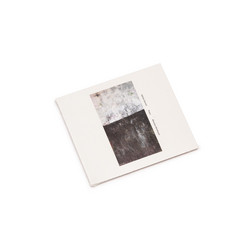
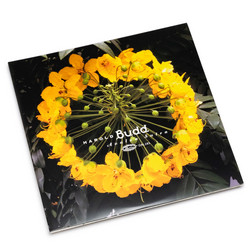
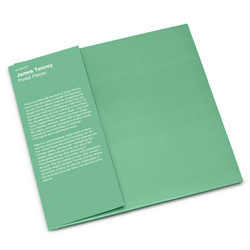
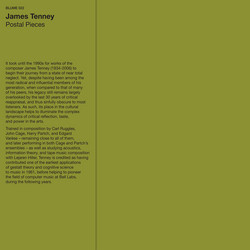
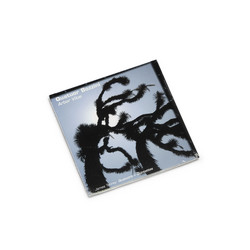
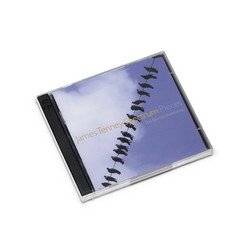
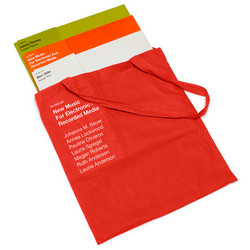
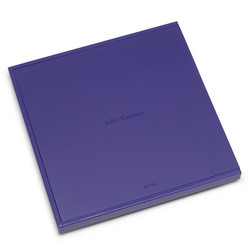
** This bundle includes both volumes of James Tenney's "Postal Pieces" on Blume in a green cotton tote bag printed with the names of the suite's eleven dedicatees: - James Tenney "Postal Pieces" (LP, BLUME 022) - James Tenney "Postal Pieces" (LP, BLUME 027). The first volume has been sold out for a long time: the copies in this bundle come from a small return from a distributor and are the last available. **
Between 1965 and 1971, James Tenney wrote eleven short compositions on the backs of postcards and mailed them to his friends. Citing a strong dislike of writing letters, he sent scores in their place: to Max Neuhaus, Alison Knowles, Philip Corner, Buell Neidlinger, Harold Budd, Malcolm Goldstein, Pauline Oliveros, La Monte Young, Susan Allen, Joel Krosnick, and John Bergamo. Completed at the newly founded CalArts in 1971 with the assistance of Knowles and Marie McRoy, the Postal Pieces are among the most important suites of 20th Century experimental music, and the clearest bridge between Tenney's roots in Fluxus and his lifelong inquiry into the quality and perception of sound.
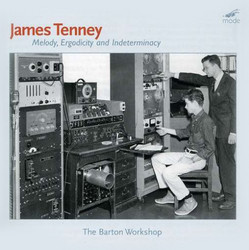
Across its two volumes, Blume has brought nine of the eleven works to vinyl for the first time, drawing on recordings made in 2003 by the Amsterdam based ensemble The Barton Workshop under the direction of James Fulkerson, each with newly commissioned liner notes by Bradford Bailey. The first volume gathers Maximusic (1965), Having Never Written a Note for Percussion, For Percussion Perhaps, or... (night), Cellogram, and Beast (all 1971). Its range runs from the metronomic clatter of Maximusic and the textural swells of the percussion pieces to the tonal relationships of the works for trombone and electronics, cello, and contrabass. The second collects the three Swell Pieces (1967-1971) and Koan (1971). Here sustained tones rise out of near silence and fall back along the same arc, and a single bowed gesture on viola is held under close scrutiny for nearly eleven minutes.
The suite is composed around three themes: Tenney's concept of swell form (repetition progressing through a structurally symmetrical arch), intonation, and the desire to produce "meditative perceptual states." Contemporaneous with the birth of minimalism among many of Tenney's closest friends, and anticipating post-minimalism, these pieces are rooted in gestalt theory and in the subjective experience of the listener. The composer almost entirely disappears. What remains is collective music: gifts, written for a community of friends, heard together here for the first time on vinyl.
Cat. number: BLUME 022 / BLUME 027