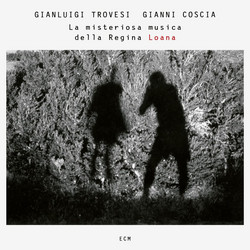
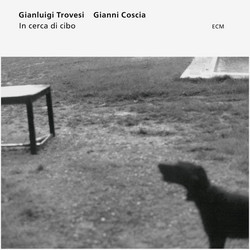
Round About Weill is the second ECM album by the Italian duo of clarinettist Gianluigi Trovesi and accordionist Gianni Coscia, after In cerca di cibo, recorded in 1999. Here they take a sideways route into the music of Kurt Weill (1900-1950), mostly songs and scenes from his work with Bertolt Brecht. Between them they place short pieces of their own written in the same spirit. As on the first record, Umberto Eco wrote the liner notes, and ECM quotes him calling the music "knowingly provocative".
Trovesi plays piccolo and alto clarinets, Coscia the accordion. The duo recorded in July 2004 at Radio Studio DRS in Zurich, with Markus Heiland as engineer and Manfred Eicher as producer. Eco's essay appears in the booklet in Italian, with English and German translations by Alastair McEwen and Burkhart Kroeber. The link with Eco goes back a long way, since he and Coscia were classmates at the liceo classico in Alessandria.
The twenty-three tracks are mostly short. Much of the Weill material comes from the opera Mahagonny: several numbered scenes, Alabama Song and Denn wie man sich bettet, so liegt man, some of them returning as variations. Tango Ballade and Youkali come from elsewhere in his output. The duo's own opener, Dov'è la città?, goes looking for the right city. In the Frankfurter Allgemeine Zeitung, Eleonore Büning heard the clarinet answer the accordion's musette cascades with a firm, falling no. Near the end the programme leaves Weill for La Cumparsita and a traditional tune.
Writing in The Irish Times in April 2005, Ray Comiskey found that "Trovesi and Coscia catch the ironic grotesqueries of Weill's often satirical world superbly". He picked out Tango Ballade, two of the Mahagonny scenes and the duo's Round About Weill I and II. In Jazzreview, Martin Longley heard Weill played "with a strong flavour of their native folklore, with a sense of light classical relief". The album was also a CD of the month in Stereoplay.
This is the CD edition, ECM 1907, first released in March 2005. Besides Eco's essay, the booklet carries liner photographs by Roberto Masotti.