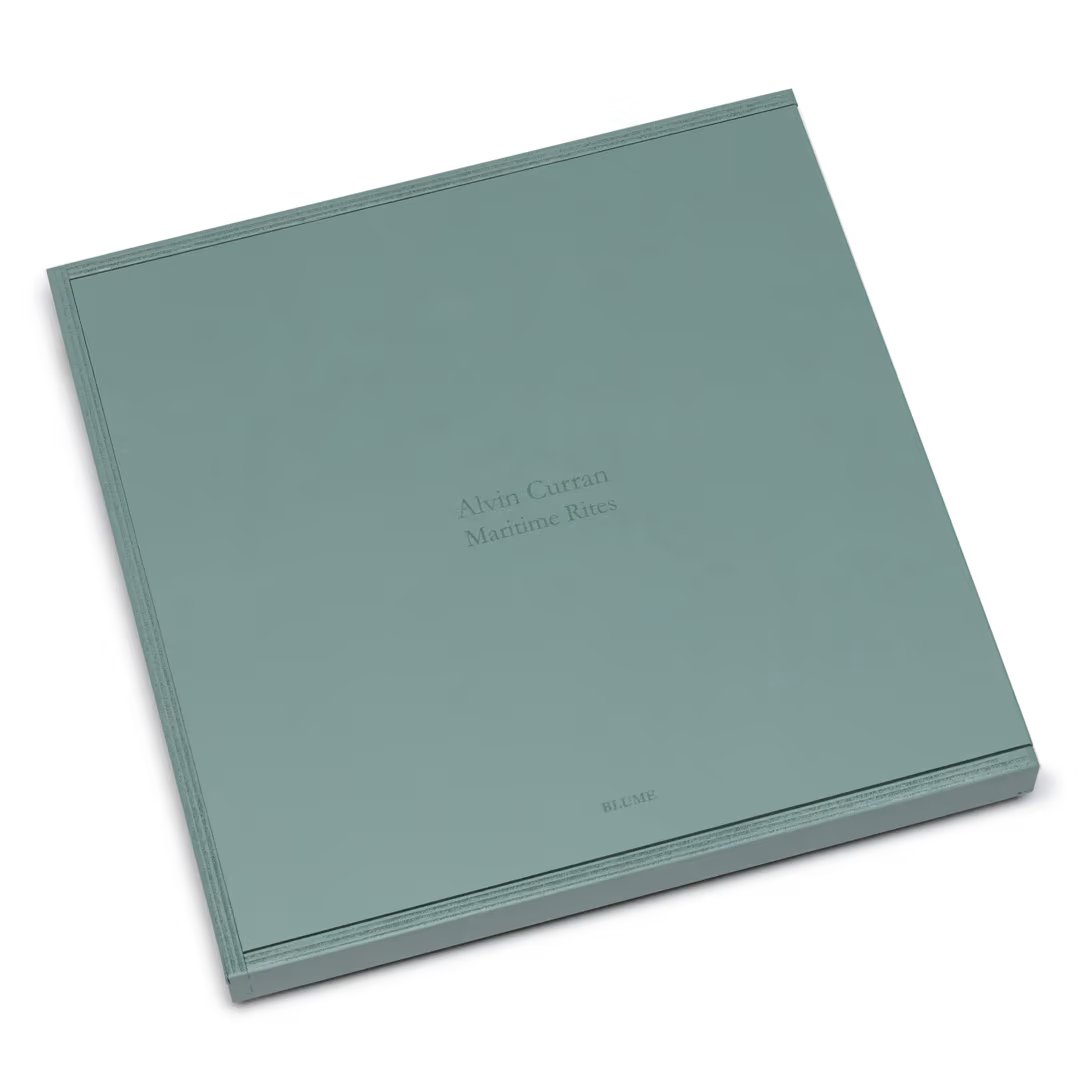
Alvin Curran
Maritime Rites (4LP Box)
Format4LP BoxLabelBlumeGenreExperimental
In process of stocking
Tracked express shipping from Italy, no customs or import VAT in the EU. Shipping costs
Edition of 300 copies, 250 available for sale. Deluxe wooden box in Chinois green with velvet lining. 4 LP on transparent turquoise vinyl, audiophile pressing, housed in Nagaoka anti-static record sleeves. Including a booklet with David Toop's liner notes from the 2004 CD release, the notes by Melissa Gould and Alvin Curran for the same release, detailed track information, biographical and discographic information, the original program note, Bradford Bailey's new liner notes and a facsimile of the 28-page 1984 Maritime Rites book, with maps, drawings and scores.
Born in Providence, Rhode Island, in 1938, with a career spanning more than half a century, Alvin Curran stands among the most important figures in both the historic and contemporary expressions of experimental music. Widely celebrated for his long-standing efforts within Musica Elettronica Viva - the collective he co-founded in 1966 with Frederic Rzewski and Richard Teitelbaum - his work as a solo composer and performer, which began to emerge into the public consciousness during the mid-1970s, has arguably yielded even greater influence and enduring effect. Noted for their groundbreaking combinations of field recording, electronics, and acoustic sound sources, now legendary albums like Canti E Vedute Del Giardino Magnetico (1975), Fiori Chiari, Fiori Oscuri (1978), The Works (1980), and Canti Illuminati (1982) - far more personal, intimate, and irreverent than those created within MEV - reveal a visionary, radical, poetic, and political voice that singlehandedly defined many of the practices we continue to associate with experimental music into the present day. Remarkably, however, the original iteration of one of Curran’s most radical and ambitious works - Maritime Rites - has remained relatively unacknowledged within his canon, perhaps due to the natural, temporal limitations of radio - the medium through which it first entered the world - and the fact that it took roughly 20 years to be released on CD, when it found home on New World in 2004.
Maritime Rites is a distillation of many streams. The recorded version, created for NPR in 1984, draws upon the radical approach toward collaborative experimentation, including intertwining electronic and acoustic sound processes, that Curran honed during the early years within MEV, as well as the practice of field recording that he helped pioneer through its applications with experimental music. While all too often overlooked within the broader historic context, the composer began making field recordings shortly after his relocation to Rome during the mid-1960s, producing works made up entirely of them, including Watercolor Music from 1966. This notably preceded the completion of Luc Ferrari’s Presque Rien No.1 - widely regarded as the first composition of this kind - by a full four years. By the end of the 1970s, Curran “began to imagine a kind of musical theatre, using sound - their sounds and their movements - mostly in outdoor places, and one of these [performances] .. in 1979, was in a lake using rowboats, in a major park in the center of Rome. It was called Maritime Rites.” For more than a half-century since, the piece has evolved and developed, becoming something of a life’s work, staged in numerous manifestations of varying character, context, and scale, realized in Minneapolis (1981), Chicago (1982), Berlin (1987), Philadelphia (1987), Sydney (1991), Kinsale (2007), London (2007), Frankfurt (2010), New York (2012), Rome (2012), Zurich (2013), Fremantle (2013), Bonn (2014), and numerous other locations, becoming what Curran describes as “something, in a way, comparable to land art: that is using large spaces as natural musical locations.” The version realized for NPR and broadcast across its radio waves during the mid-1980s, however, is reasonably distinct.
The version of Maritime Rites comprised by Blume’s first ever vinyl edition draws upon extensive field-recordings made on the coast and at sea, between Virginia and the upper reaches of New Brunswick, Canada, made during the summer of 1984, when Curran embarked upon what he describes as “a month-long adventure on land and sea”, initially conceived with the objective of “recording all of the fog horns and all of the varied types of ship horns along the eastern seaboard.. with the help of the United States coast guard and a few local lobstermen.. individuals who would let me record them.. on boats, in certain sites and certain places where I could start to make the recordings.” Casting these “open and naturally beautiful sites” as “new music theaters”, the composer then enlists a constellation of friends and fellow artists - Wadada Leo Smith, Pauline Oliveros, Steve Lacy, Clark Coolidge, Joseph Celli, Jon Gibson, Malcolm Goldstein, George Lewis, and John Cage - as active collaborators, in each case traveling to meet the artists, wherever they might have been at that moment, and recording them in-situ, with an offer of complete freedom to contribute according to their desire, before later “mix[ing them] with respect”, into the resulting nine, roughly eleven minute “concerts” - each featuring one of its collaborators - placed alongside a tenth, twenty-four minute iteration, that finds Curran as its instrumentalist: his interventions on gongs, whistles, vocals, and conch shells meticulously entwined with the reformed ambiences of the eastern seaboard.
Radically reimagining electroacoustic practice within visionary new, collaborative terms, culminating as a profoundly democratic expression of music in both its form and vehicle for distribution, the remarkable ten movements of Maritime Rites, amounting to more than two hours of groundbreaking sounds, remain among the most singular and ambitious statements of Curran’s remarkable career. More than four decades on, they remain an enduring proof of how ahead of his time the composer has always been. Refracting complex conjunctions of place, community, collaboration, memory, and the self, Maritime Rites stands as one of Blume’s most ambitious and historically significant releases to date.
Maritime Rites is a series of ten environmental concerts for radio composed by Alvin Curran. This series features the Eastern Seaboard of the United States as a musical source in collaboration with improvised musical performances by ten distinguished artists in the American new-music scene: John Cage, Joseph Celli, Clark Coolidge, Jon Gibson, Malcolm Goldstein, Steve Lacy, George Lewis, Pauline Oliveros, Leo Smith, and Alvin Curran. The programs use specifically recorded natural sounds as musical counterpoint to the soloists, whose improvisations are freely restructured and mixed by Curran. As nature is spontaneous and unpredictable, so is the music of man. Curran simply brings the two together in a common radiophonic sound-space letting both chance and intention make the music. Featured here are the foghorns of Virginia, Maryland, Delaware, New Jersey, New York, Connecticut, Rhode Island, Massachusetts, New Hampshire, Maine, and New Brunswick, Canada. Also included are maritime bells, gongs, whistles, and regional bird and animal life. Comments from lighthouse keepers, Coast Guard personnel, and other local people are woven impressionistically throughout.
There are nine eleven-minute programs, each featuring a specific artist as soloist. The tenth program of about twenty-five minutes features Curran in a closing work of “symphonic” dimensions.
Rich in ambient detail, Maritime Rites presents the foghorn as indigenous American “found” music par excellence and the source of one of the most enduring minimal musics around us. The series is also a comprehensive aural documentary of our regional and national maritime heritage, including such historical sounds as the Nantucket II Lightship, now out of service and doing duty as a museum docked in Boston Harbor. The Lightship’s horn is the only one of its kind (and the loudest!) on the East Coast and was recorded extensively during an exclusive session ten miles offshore with the special cooperation of the ship’s crew. As the foghorn gives way to other electronic navigational aids, this work may serve as an historical document of some of the most beautiful and mysterious sounds of the sea.
As an expression of sonic geography, Maritime Rites brings together different areas of the Seaboard in a single musical moment. The series was expressly conceived for radio, the only medium that can safely accommodate more than sixty foghorns at once and bring an entire coastline, seemingly live, into anyone’s home!
Produced by Alvin Curran and Melissa Gould. Mixed and engineered by Nicola Bernardini and Alvin Curran in Rome in 1985. Liner notes by David Toop and Bradford Bailey. Graphic layout, restoration and printing by Legno, in Milan. The booklet cover is on Cordenons Dalì Perla paper, the inside pages on Cordenons Modigliani Camoscio.
Release notes
Limited edition of 300 copies, 250 of them for sale, in a Chinois green wooden box with velvet lining. Four LPs on transparent turquoise vinyl. With a booklet that includes liner notes by David Toop and Bradford Bailey, the original program note and a facsimile of the 1984 book. Ten environmental concerts for radio, produced for National Public Radio in 1984 and 1985 and here on vinyl for the first time.
| LP 1, Side A | |||
| A1 | World Music | 11:06 | |
| A2 | Rattlesnake Mountain | 10:52 | |
| LP 1, Side B | |||
| B1 | Coastline | 11:41 | |
| B2 | Mine | 11:18 | |
| LP 2, Side C | |||
| C1 | Improvisation | 11:02 | |
| C2 | Soft Shoulder | 11:07 | |
| LP 2, Side D | |||
| D1 | Program Introduction: World Music | 1:31 | |
| D2 | Program Introduction: Rattlesnake Mountain | 1:29 | |
| D3 | Program Introduction: Coastline | 1:20 | |
| D4 | Program Introduction: Mine | 1:28 | |
| D5 | Program Introduction: Improvisation | 1:41 | |
| D6 | Program Introduction: Soft Shoulder | 1:24 | |
| LP 3, Side E | |||
| E1 | From Center Of Rainbow, Sounding | 11:08 | |
| E2 | Improvisation | 11:15 | |
| LP 3, Side F | |||
| F1 | Ice, Dew, Food, Crew, Ape | 11:27 | |
| LP 4, Side G | |||
| G1 | Maritime Rites | 23:43 | |
| LP 4, Side H | |||
| H1 | Program Introduction: From Center Of Rainbow, Sounding | 1:34 | |
| H2 | Program Introduction: Improvisation | 1:31 | |
| H3 | Program Introduction: Ice, Dew, Food, Crew, Ape | 1:16 | |
| H4 | Program Introduction: Maritime Rites | 3:05 | |
- Alvin Curran
- Composed By, Mixed By, Recorded By, Producer, Engineer, Liner Notes, Voice (G1)
- David Toop
- Liner Notes
- Nicola Bernardini
- Mixed By, Engineer
- Melissa Gould
- Recorded By, Liner Notes, Producer
- Bradford Bailey
- Liner Notes
- Leo Smith
- Trumpet, Horn [Seal Horn] (A1)
- Pauline Oliveros
- Accordion (A2)
- Steve Lacy
- Soprano Saxophone (B1)
- Clark Coolidge
- Voice (B2)
- Joseph Celli
- Oboe, Saxophone, English Horn, Performer [Mukha Veena] (C1)
- Jon Gibson
- Soprano Saxophone (C2)
- Malcolm Goldstein
- Violin (E1)
- George Lewis
- Trombone (E2)
- John Cage
- Voice (F1)


