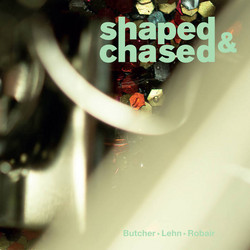
**2026 Stock** Embrace 2: Chains and Grain presents Polwechsel turning their long‑honed language back on itself. Written by percussionist Martin Brandlmayr, the piece is built not from imported ideas or outside concepts but from material the players generated themselves, then re‑shaped and re‑notated with forensic care. Rather than imposing a foreign framework on the quartet, Brandlmayr starts with their characteristic sounds, gestures and micro‑habits, and asks what happens if those are fed into a new system of repetitions, instructions and open spaces. The result is music that sounds unmistakably like Polwechsel and yet behaves like a living organism that never settles, a work designed to be “recreated every time we play it”.
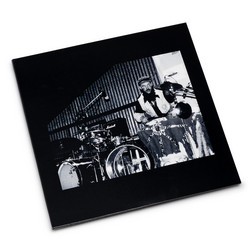
The quartet line‑up is stripped to its core: Michael Moser on cello, Werner Dafeldecker on double bass, Burkhard Beins on percussion, and Brandlmayr on percussion and transducer. In Chains and Grain, each player’s approach is treated as both raw material and constraint. Brandlmayr’s score calibrates “the quality and degree of precision with which musical material is repeated and how it is notated”, so that some cells demand near‑identical recurrence while others invite deviation or erosion. As these chains of events unfold, the “grain” - the small differences in attack, timbre, duration, timing - becomes the real subject. It’s in those tiny shifts that the music breathes, revealing how much variation can arise inside what looks, on paper, almost the same.
Crucially, the piece is conceived to preserve real‑time interaction. However detailed the notation, Brandlmayr insists on leaving space “for interaction that is developed in the moment”, ensuring that Chains and Grain remains a “living thing”. You can hear this in the way patterns lock together and then subtly misalign, in the way a bowed cymbal or rubbed drum skin suddenly responds to a low string resonance, or in the small hesitations that open just enough room for someone else to speak. The transducer work folds electronics into the acoustic surface, transmitting vibrations through instruments and objects so that the boundary between struck, bowed and electrically animated sound becomes porous.
Recorded in July 2021 at ORF Argentinierstrasse by Andreas Karlberger with assistance from Ingrid Song, the album captures the ensemble with the spatial clarity their music requires: close enough to hear the scrape and air around each gesture, yet wide enough to perceive the shifting relationships between voices. Mixing by Brandlmayr and Dafeldecker emphasises those relationships, letting chains of repetition and their gradual fraying emerge in sharp relief, while Wolfgang Musil’s mastering preserves both the music’s dynamic restraint and its sudden swells of density.
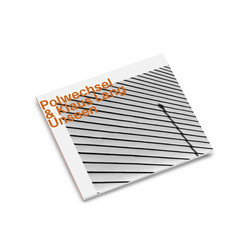
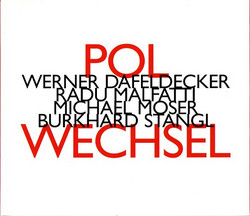
Visually, Embrace 2 is framed by artwork from Teresa Iten and LP cover art by Michael Moser, extending the record’s concern with structure and texture into graphic form. Together, sound and image reinforce the sense of a practice still evolving from within: Polwechsel using their own history as raw material, subjecting it to new rules and conditions, and listening closely to what emerges. As a counterpart to Embrace 1, Chains and Grain underlines the group’s commitment to treating composition, notation and improvisation as interlocking processes rather than separate camps - a quietly radical stance that continues to generate some of the most detailed and compelling ensemble music of the present.