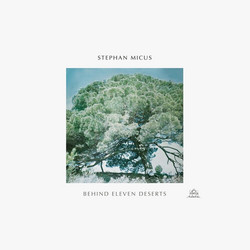
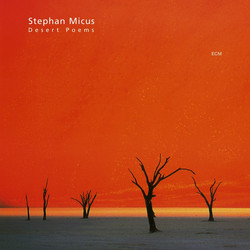
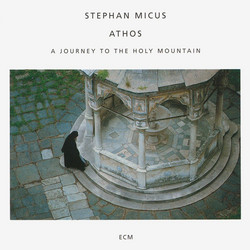
CD version. The Garden Of Mirrors is the fourteenth album by Stephan Micus. The German multi-instrumentalist learns instruments from many cultures, then uses them for music that belongs to none of them. Released by ECM in 1997, it is built around two West African harps, the bolombatto and the sinding, which Micus counts among his most rhythmic records.
Micus first met the two harps in Gambia about eight years before the album, and studied them there with the help of local musicians. The bolombatto has gut strings, the sinding strings of hemp. Here he is the only performer, singing and playing everything himself and layering the parts in the studio. Around the harps he uses steel drums, Indonesian suling flutes, Japanese shakuhachi, the nay, tin whistle and percussion. The music was recorded in 1995 and 1996 at MCM Studios, the cover designed by Dieter Rehm.
The nine pieces form one sequence, numbered as parts. Earth opens with the bolombatto under a choir of twenty voices, all of them Micus, and the same massed voice returns over sinding in Violeta and Night Circles. Elsewhere the scoring is pared down to one family of instruments. There are twenty-two suling in Flowers In Chaos, a solo tin whistle in Mad Bird, six shakuhachi in the closing Words Of Truth. Gates Of Fire gathers almost everything at once, from steel drums and bowed sinding to five shakuhachi, four nay and three tin whistles.
Micus insists that this is not African music, though the harps "create this sort of African ambience". He also said he had never used instruments with such low tones, "they're like a primitive bass", and that playing them brought him closer to the roots of black American music. Down Beat called the album "remarkable, haunting and truly timeless". El País found that it kept the virtues of his first works, "freshness, imagination and a talent for intercultural synthesis". For La Repubblica it was his first record since Athos, and one that explores an inner world governed by natural elements and by silence.
CD, ECM 1632, first released in August 1997.