Triptykon is an early document of Jan Garbarek as a free improviser, a trio date with his Norwegian colleague Arild Andersen on bass and the Finnish percussionist Edward Vesala. It was Garbarek's third album for ECM, after Afric Pepperbird and Sart. Between open improvisation and Norwegian folk melody, it points to the direction his music would take in the following years.
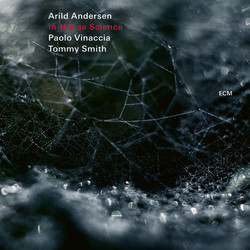
The trio recorded in a single day, 8 November 1972, at the Arne Bendiksen Studio in Oslo. Manfred Eicher produced and Jan Erik Kongshaug was the engineer. Garbarek plays soprano, tenor and bass saxophones and flute. Six of the seven pieces are credited jointly to the players. The seventh, Bruremarsj, is a traditional Norwegian wedding march, played with saxophone and bowed bass. Andersen had played on both earlier albums, while Vesala took the place of their drummer, Jon Christensen. It was the first time Garbarek recorded for ECM without a guitar or piano.
The opening Rim sets the tone with long, mournful tenor cries over Andersen's bass. Selje is a brief folk-like melody, played by Garbarek on a wooden flute over bass and glockenspiel-like chimes. The title piece runs almost thirteen minutes, the longest on the record. It gives Andersen an extended solo passage and has Garbarek on soprano saxophone, moving between plain, song-like phrases and harder, more Coltrane-like runs. Elsewhere the music turns agitated, as in the tenor and percussion duet Etu Hei!.
Reaction at the time was divided. In Jazz Journal in October 1973, Martin Davidson found that Rim revealed Garbarek as "a strong and original tenor player", but he was hard on Vesala and on some of the shorter pieces. Writing later for AllMusic, Brian Olewnick described "an expressionist trio drawing on both free improvisation and Scandinavian folk tunes" and heard in it an aural equivalent of Edvard Munch. The Swiss weekly Weltwoche wrote in 1973 that in this Norwegian triptych free jazz had found a form that did not need to be feared as a shackle.
This CD edition carries the original catalogue number ECM 1029 and the seven tracks of the album, first released by ECM in April 1973.