Wadada Leo Smith
Procession of the Great Ancestry
**2026 stock** Recorded in February 1983 at Nessa’s Acme studio in Chicago, Procession of the Great Ancestryfinds Wadada Leo Smith refining his sense of musical lineage into a clear, resonant statement. Best known today as both a major composer and a long‑time educator (including his work at CalArts), Smith is heard here in a focused mid‑career phase: the music is concise yet conceptually rich, grounded in blues and swing while continually bending form and texture toward his own purposes. The album’s core is a cycle of four compositions dedicated to trumpet masters Miles Davis, Dizzy Gillespie, Booker Little and Roy Eldridge, each piece functioning less as a stylistic imitation than as a distilled reflection of what their sound and stance opened up for him.
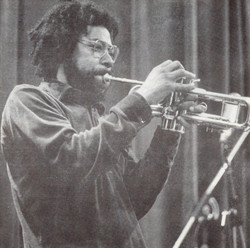
The primary ensemble is a quartet: Smith on trumpet, flugelhorn, kalimba and voice; Bobby Naughton on vibraharp; Joe Fonda on bass (acoustic and electric); and Kahil El’Zabar on drums, balafon, kalimba and percussion. It’s a lean line‑up that yields a surprisingly broad palette. Naughton’s vibes provide luminous, chiming harmony and counter‑rhythm; Fonda grounds the music with supple lines that can suddenly surge forward or drop to a murmur; El’Zabar’s percussion brings a strong sense of ritual, drawing on African diasporic grooves and hand‑drummed textures as much as on conventional kit work. Against this, Smith’s horns trace melodies that are at once declarative and questioning, often moving in short, etched phrases rather than long bebop lines, the space around each note carrying as much weight as the note itself.
The four trumpet dedications open the album’s narrative. Without resorting to quotation, Smith captures something of each figure’s aura: Davis’ distilled lyricism and use of space, Gillespie’s kinetic charge, Little’s compressed intensity, Eldridge’s fiery bravura. These qualities are refracted through his own compositional lens, shaped by his Ankhrasmation language of symbols and colours. Pieces shift between open time and subtle grooves; themes surface, recede and reappear; kalimba and balafon introduce earthy, resonant timbres that link the music to deeper ancestral currents. The album’s title, Procession of the Great Ancestry, speaks to that larger frame: this is not just a trumpet record, but a meditation on how creative lineages move through individuals and communities.
On two vocal tracks, the ensemble expands to include bassist Mchaka Uba and blues legend Louis Myers on electric guitar, bringing the church and the barroom directly into Smith’s soundworld. Here, the music leans more overtly into song form: electric bass, guitar riffs and vocal delivery underline the continuity between avant‑garde jazz practice and the blues tradition that underpins it. Smith’s voice, like his horn, is used sparingly but with intent, turning lyrics and chants into extensions of the horn’s phrasing rather than a separate layer. The presence of Myers - a veteran of the Chicago blues scene - anchors the record in the city’s broader musical ecology, making the “procession” not only historical but also deeply local.
The closing piece, “Nuru Light: The Prince of Peace,” is a tribute to Martin Luther King Jr., with the quartet joined by tenor saxophonist John Powell. At just over three minutes, it is concise but emotionally dense, drawing on hymn‑like harmony and a restrained, singing approach to melody. Powell’s tenor adds a warm, human grain to the ensemble sound, weaving around Smith’s trumpet in lines that evoke both lament and quiet resilience. Rather than attempting to summarise King’s life or the civil rights struggle in broad gestures, the piece offers something more intimate: a concentrated moment of clarity and light at the end of a journey through musical ancestry and social memory.
Though relatively obscure in Smith’s large catalogue, Procession of the Great Ancestry has come to be recognised as one of his most satisfying and finely balanced recordings. It brings together key strands of his practice - dedications as compositional engines, integration of African instruments, engagement with blues and song, political and spiritual tribute - within a compact, coherent framework. As a listening experience, it moves with the steady, purposeful gait its title suggests: a procession in which each piece steps forward to honor a figure or a force, then falls back into the larger flow, leaving behind a resonance that continues long after the music fades.